AI-native software studio · Singapore

We make software AI-native.

We build custom web and mobile apps, platforms and AI features on architecture that fits your scale, ready for AI agents from the start. Already running a system? We can add features, help it scale, rebuild what holds it back, or connect it to AI assistants such as ChatGPT and Claude through MCP.

  • Free initial consultation by email
  • NDA on request
  • You own the code
Founded by Kyle, the first architect for product systems at a company that grew to over a billion users. Kyle personally designs and builds every project. Meet the founder
Fig. 1 · tarn n. A small mountain lake — clear, calm and surprisingly deep.

AI-native

What AI-native means

We design new software to be AI-native by default, with interfaces and access controls for AI assistants and agents. Specific integrations are agreed in the project scope. A simple booking system can be AI-native without AI features of its own.

  • People Web and mobile apps for your team and customers
    UI
  • AI assistants Claude, ChatGPT, Gemini, Copilot and more
    MCP
  • Agents Your own agents, automations and partner systems
    API
Shared guardrails Permissions, approvals and audit logs
Your system Data, business logic and actions
Fig. 2 · System One system, three ways in, the same rules for all.
  • 01

    MCP servers

    Your system's data and actions, available through the Model Context Protocol (MCP), the open standard AI assistants use to connect to tools. Your team's and your customers' assistants can then look things up, create records and run workflows in your system directly.

  • 02

    Agent-ready APIs

    Clear schemas, descriptions and errors, so agents can call your system without guesswork. Every other integration benefits too.

  • 03

    Built for agent traffic

    Agent-driven workloads can generate bursts of requests and retries. Rate limits and caching manage load; idempotency controls prevent retries of the same operation from creating duplicate orders or charges.

  • 04

    AI in the product

    Search, summaries, drafting and data extraction inside your own screens, with answers grounded in your data, not generic ones.

  • 05

    Knowledge, ready for AI

    Retrieval-augmented generation (RAG) retrieves relevant documents and records to ground model responses, with synchronised sources, access controls and source references.

  • 06

    Guardrails and evaluation

    Permissions, prompt injection defences, human approval, audit logs and evaluations to track agent actions and measure performance.

Our view

Software of your own

Most people and businesses have had to fit themselves around off-the-shelf software. Building with AI agents is changing the economics: software shaped around one shop, one team or one person is becoming practical to build and run.

We think every person and every business will want software of their own. You don't need a tech team for it: we start with the part that saves you the most time, build it, and can run it for you on our managed cloud.

  • For a café

    Orders, stock and a chat assistant that knows the menu, the suppliers and the regulars.

  • For a clinic

    Bookings, reminders and patient notes, shaped around how its doctors actually work.

  • For one person

    A small app that takes one chore off your hands, such as a budget tracker that keeps everything on your phone.

Services

What we build

Custom software, AI-native by default: design, development, deployment and operations. A simple product does not require built-in AI features to be ready for AI agents.

  • 02

    Web apps, platforms and backends

    Customer portals, booking systems, internal tools, SaaS platforms, APIs and backend services, designed for the number of users you expect. For systems you already run, we add features, fix performance and scaling bottlenecks, or rebuild the parts you've outgrown.

    Web apps · APIs · Architecture and scaling

  • 03

    Mobile apps

    iOS, Android and cross-platform apps, from the first prototype to launch. You publish them on the App Store and Google Play under your own accounts, and we guide you through submission and review.

    iOS · Android · Cross-platform

  • 04

    AI features and agents

    Assistants, knowledge-base search, document processing and agents that automate multi-step work, built on the model that fits the job, with evaluation from day one.

    LLMs · RAG · Agents

  • 05

    Outsourced development

    Hand us a whole project, or bring us in alongside your own team. Clear scope, steady progress and a clean handover, with support after launch.

    End-to-end delivery · Alongside your team · Maintenance

06

Managed cloud

Have your own servers or cloud account? Deploying there is part of every project, with no extra fee from us. If you have neither, our managed cloud runs your system in BlueTarn's account on AWS, Google Cloud or Cloudflare, and we can register a domain in your name or use one you already have. We estimate what it needs and quote one price covering cloud resources, the domain, management and any AI model usage, billed annually; if usage grows well beyond the estimate, we agree the new price with you first. After the 30-day fix period, upgrades that move to a new major version or need code changes, even for a security fix, are billed monthly as maintenance. Once the project and any later invoices are paid, you can move it to your own account at any time; the migration may be quoted separately. Your data is yours to export at any time.

AWS · Google Cloud · Cloudflare

  • Infrastructure as code
  • CI/CD pipelines
  • Monitoring and alerts
  • Backups and recovery
  • Security patches for the hosting platform and dependencies
  • Cloud, AI usage and the domain in one quote
  • Bring your own model API keys

We also take on small projects for individuals: static websites and apps that need no backend. Not sure where your project fits? Tell us about it

Why work with us

Senior engineering, built with AI agents

Whether it's a small app or a core system, you get software that fits your scale, comes tested and documented, and keeps running after launch.

  1. Right-sized architecture

    Kyle, our founder, has over ten years of architecture experience, including as the first architect for product systems at a company that grew from one million users to over a billion. No paying for scale you don't need yet, and a clear path to grow when you do.

  2. Designed and built by Kyle

    Kyle handles architecture and implementation for every project. The team runs deployment, operations and maintenance for the systems we look after.

  3. Code others can build on

    Since 2011, Kyle has built frameworks used by tens of thousands of engineers. Readable code, tests and technical documentation come as standard, so your own team, or anyone you hire later, can pick it up.

  4. Working software in weeks

    We build every project with AI agents. Small and medium projects are usually delivered in one to two weeks once the scope is agreed and we have capacity to start, with a preview to try every few days.

Our products In development

Apps and AI tools of our own

Alongside client work, we're building AI-native apps and tools of our own, starting with the apps people open most each day. They'll be offered as simple subscriptions.

Be the first to try them when they launch.

  • AI-native apps

    Mobile and web apps designed around AI from the first screen, for everyday work and life.

  • AI extensions

    Extensions and MCP servers that give the assistants and tools you already use new abilities.

  • Simple subscriptions

    Clear plans and honest pricing. We collect only the data a product needs, and never sell it.

Everyday apps, AI-native

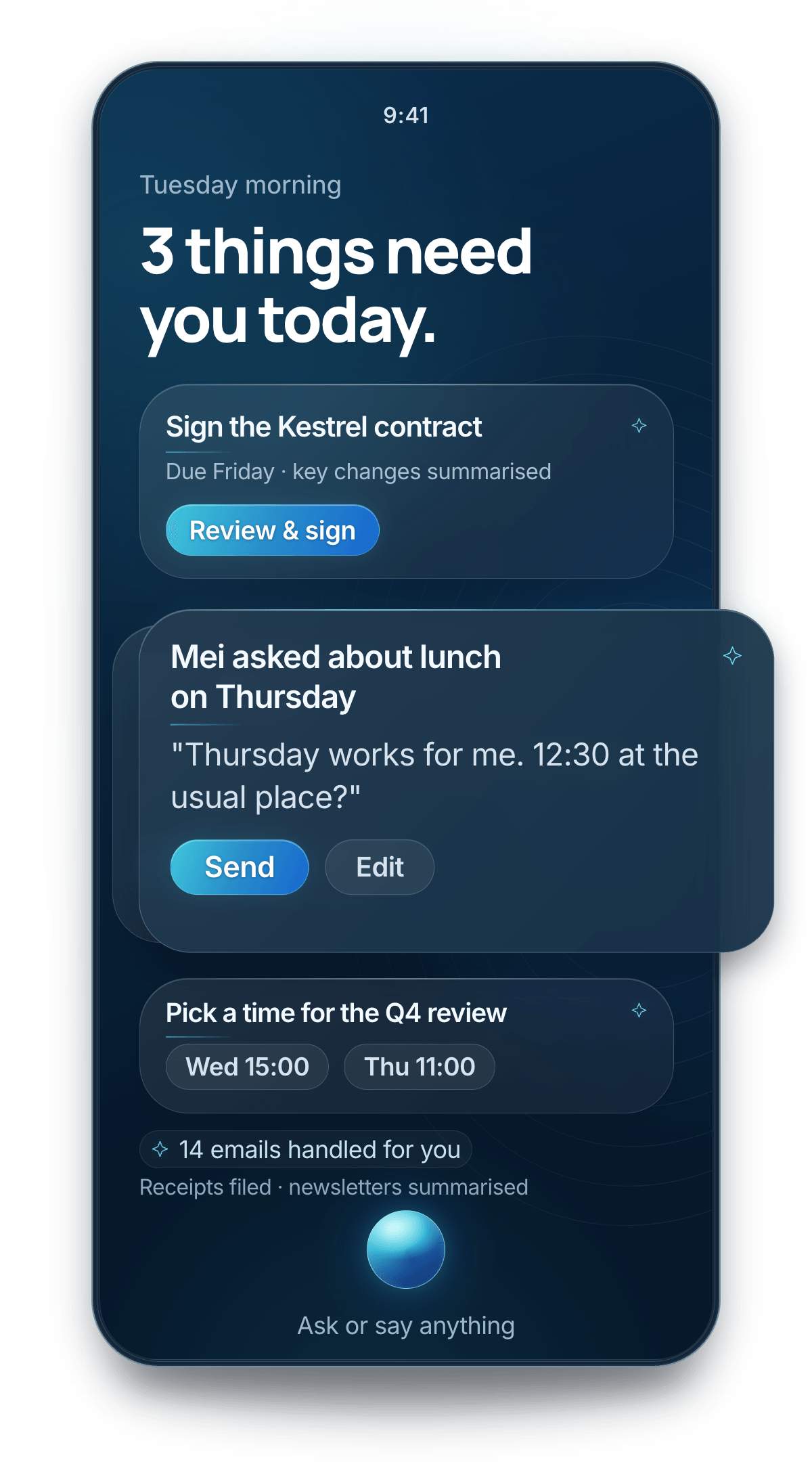
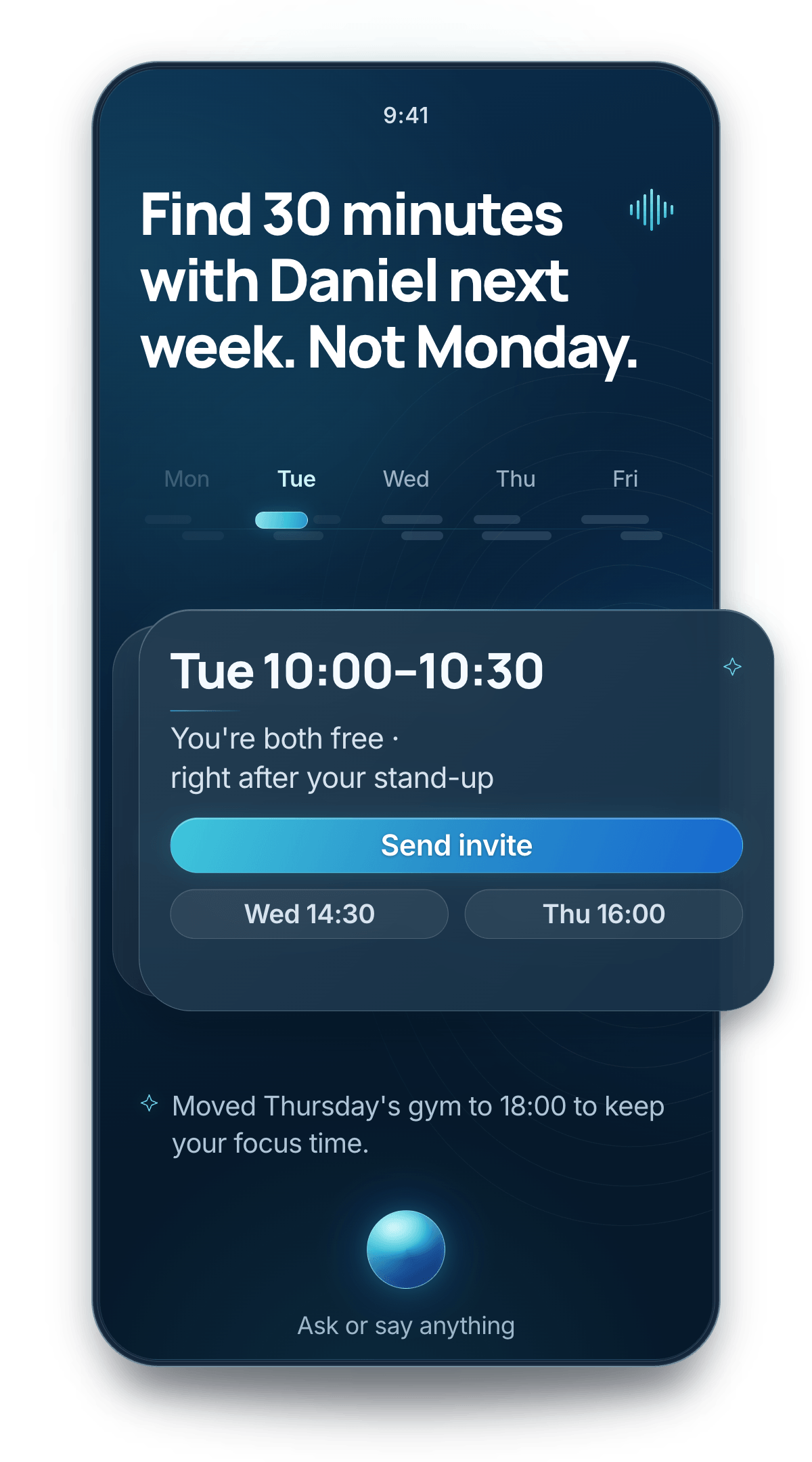
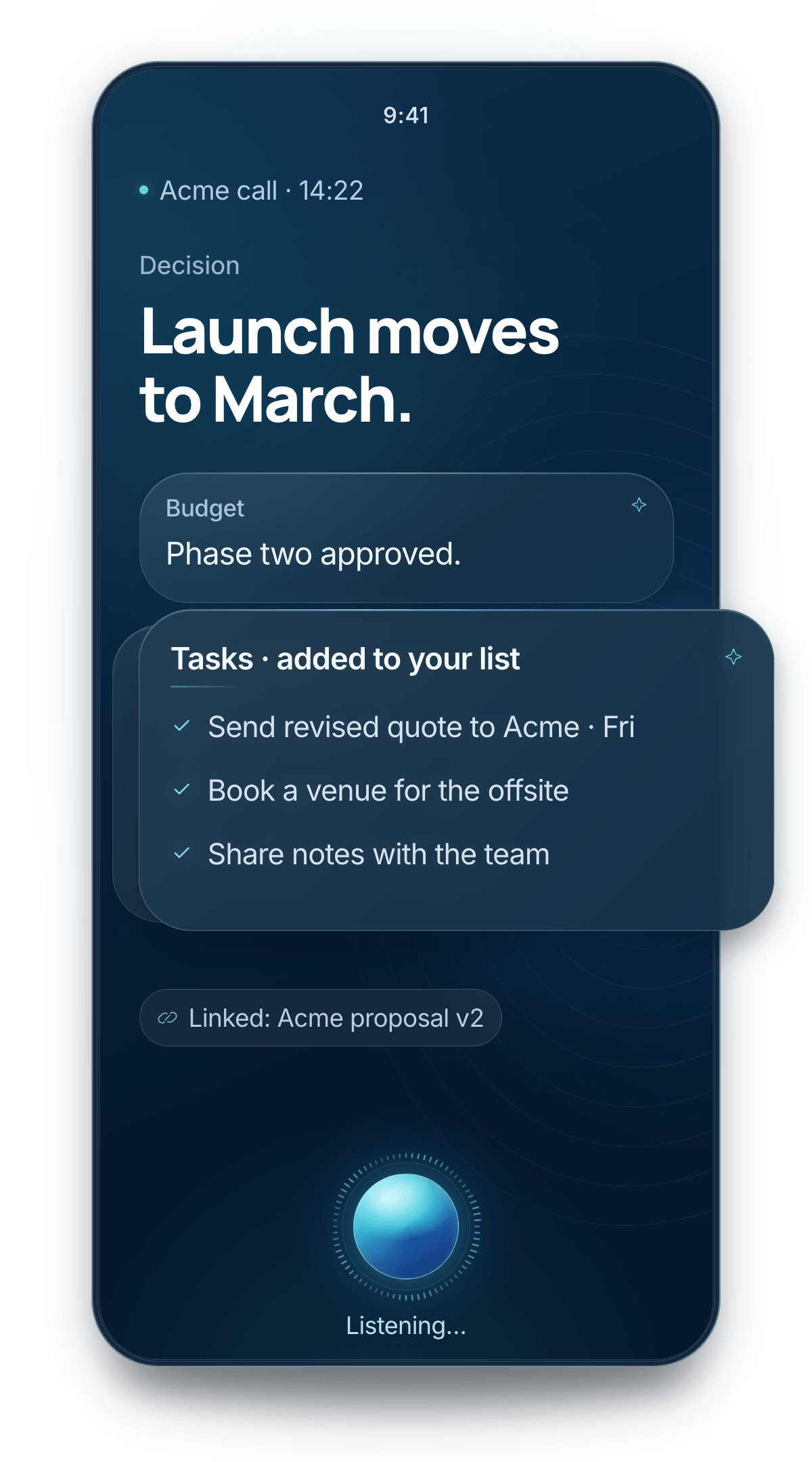
Concept designs for the apps people open most each day, rethought around AI: less to manage, more done for you, and a person approving what matters.

  • Concept of an AI-native mail app: three decisions for the day, a drafted reply and 14 emails already handled
    Fig. 3 Mail No inbox to manage. It handles the routine and brings you only the decisions.
  • Concept of an AI-native calendar app: a spoken request and the proposed time glowing on a week timeline
    Fig. 4 Calendar Say what you need. It finds the time, rearranges the rest and asks before sending.
  • Concept of an AI-native notes app: a live call turning into a decision, a budget note and tasks
    Fig. 5 Notes Listens with you and turns the conversation into decisions and tasks as it happens.

How we work

From initial consultation to long-term support

A simple, predictable process, so you always know what's happening and what comes next.

Fig. 6 · Section A–A′ Each step goes a little deeper. Support is the long, steady floor.
  1. Discover

    A free initial consultation by email to discuss your goals, users, existing systems and timeline, including whether AI features would help.

  2. Plan

    A written proposal covering scope, milestones, a fixed price or budget, and architecture appropriate to your scale. For AI features, we specify models, data access and guardrails.

  3. Build

    Working previews every few days for small and medium projects, and every week or two for large ones. We evaluate AI features alongside standard software testing.

  4. Launch

    We deploy to your servers or cloud account, or our managed cloud if you have neither, and verify the system in production. You publish mobile apps under your own App Store and Google Play accounts, with our guidance on submission and review. We hand over deployment configuration and access details for systems in your own environment. For new software, the code and documentation come as one package once the project is paid in full. Bugs in the agreed scope found within 30 days of launch are fixed free of charge.

  5. Support

    After those 30 days, we can stay on for maintenance, upgrades and new features, billed monthly for the time spent, within a budget we only exceed with your approval. For new software, you can ask for an updated code package once the project and the invoices for that work are paid. On our managed cloud, security patches for the hosting platform and dependencies are included in the annual price; upgrades that move to a new major version or need code changes, even for a security fix, are billed monthly as maintenance.

About

Infrastructure, then architecture at scale. Now AI-native.

Kyle

Founder, BlueTarn

Kyle personally designs and builds every project: the architecture, the code and any AI features, bringing that experience to your project first-hand. We take on a limited number of projects at a time and document as we go. The team, not one person, runs deployment, operations and maintenance for the systems we look after.

Founded
2026
Based in
Singapore
Focus
AI-native custom software
Languages
English, Chinese (Mandarin)
A clear blue mountain lake below rocky peaks
Fig. 7 · Plate

“Outside work, I run marathons, dive, hike and climb mountains. High up, you sometimes come across a tarn: small, and blue because its water is clear and deep. That's what I want BlueTarn to be: a small team that's clear about how we work and deep in what we build, with the stamina to stay with your project for the long run.”

The path so far

  1. Infrastructure

    Frameworks for tens of thousands of engineers

    Built service frameworks from 2011 onwards, used first by a department of thousands of engineers and later by tens of thousands.

  2. Architecture

    First architect for product systems

    Joined a company as one of its first 100 employees and was there as its users grew from one million to over a billion. Designed core services, from product backends to storage, and owned the first-generation object storage behind its video apps. Spent over ten years as an architect in all.

  3. AI-native

    Founder, BlueTarn

    Founded BlueTarn in 2026 to build AI-native software for clients, and apps of its own.

What Kyle is researching now

Not training models, but the layer above them: the harnesses, protocols and infrastructure that let models do reliable work inside real systems.

  • Agent harnesses

    The loop around the model: tool calls, planning, retries, sandboxes and permissions. It's what turns a model into an agent you can trust with real work.

  • MCP

    MCP servers and tools that agents use well: clear tool boundaries, remote deployment, authorisation, tightly scoped access and defences against prompt injection.

  • Context engineering

    Getting the right information to the model at the right time: retrieval, memory and compaction to keep the context window focused, and prompt caching to keep cost and latency down.

  • Evals

    Testing agent behaviour as rigorously as any other software: datasets, graders (some of them models) and regression checks run many times over, catching quality drops before users do.

  • Agents in production

    Long-running, resumable tasks, tracing and cost control, plus backends that stay steady when agents, not people, drive the traffic.

  • Multi-agent systems

    Splitting work across agents and sub-agents, using protocols such as A2A, without losing track of who did what.

FAQ

Questions, answered

Something else on your mind? Email contact@bluetarn.ai and we'll get back to you.

How do you price your work?

The initial consultation by email is free. Each project is quoted on its size and scope; small projects with one clear job start from SGD 2,000 to build, with running costs separate. A larger existing system may need a short paid assessment first, credited against the project if you go ahead. Your written proposal sets the scope and how it's billed: a fixed price, paid by milestone, or monthly billing for the time spent, within a budget we only exceed with your approval. Scope changes are quoted before we start them, and every project includes 30 days of free fixes after launch for bugs in the agreed scope.

How long does a project take?

Small and medium projects are usually delivered in one to two weeks once the scope is agreed and we have capacity to start, excluding app store review time for mobile apps. Large projects are split into milestones, with dates in the proposal.

  • Small: one clear job, such as a static website, an app that needs no backend, an internal tool for one team, an MCP server on an existing API, or an AI feature in an app you already have
  • Medium: a focused product for one main group of users, such as an MVP web or mobile app with sign-in
  • Large: several user groups or connected systems, data migration, strict compliance or high user scale, such as rebuilding or scaling a long-running core system, or making it AI-native
How do you handle the risk of depending on one person?

We take on a limited number of projects at a time and accept a new one only when we're confident we can deliver it on time and to a high standard. When we're fully booked, we tell you when we expect to have capacity, and the project can start then. We document as we go, and the team, not one person, runs deployment, operations and maintenance for the systems we look after. Delivery dates are set in your written proposal, and any delay is handled as the contract sets out.

Who owns the code?

You do. Once a fixed-price project is paid in full, the source code, designs and related intellectual property are yours, as is work billed monthly or added later, once its invoices are paid. Open-source components keep their own licences. General-purpose tools and components we bring to a project, and our improvements to them, stay ours, and once you own the software, you get a perpetual licence to them as part of it. For new software we build, we hand the source code and documentation over as a package once the project is paid in full, and an updated package on request after later changes, once the project and any invoices for them are paid; the repository we work in, and its change history, stay with us. Changes to systems you ran before working with us, and work alongside your own team, aren't held back this way; your written proposal says which applies. We never use a client's code, data or confidential information in our own products, and we're happy to sign an NDA before you share any details.

Does every project need AI features?

No. AI-native is our default: we build every project with AI agents and design new software for agent integration. A simple internal tool or customer portal does not require built-in AI features. Specific integrations are agreed in the project scope.

What happens to our data, and which AI models do you use?

We handle personal data in line with Singapore's Personal Data Protection Act (PDPA). We do not use client data to train models. We agree data storage and model inference locations for each project. We choose Claude, GPT, Gemini or open-weight models for quality, cost, latency and data requirements, with the flexibility to switch. Each AI feature has only the access it needs.

What does it cost to run, and who pays?

On your own servers or cloud account, deployment costs nothing extra from us, and you pay your providers directly. If you have neither, our managed cloud runs the system in BlueTarn's cloud account under one quote for cloud resources, the domain, management and any AI model usage, billed annually; if usage grows well beyond what we estimated, we agree the new price with you first. We can register the domain in your name or use one you already have, and you can bring your own model API keys so AI usage is billed to you directly. Apps go on the App Store and Google Play under your own accounts, so you pay Apple's and Google's developer account fees directly.

Do you work with clients outside Singapore, and with individuals?

Yes to both. We're based in Singapore (UTC+8) and work in English and Chinese (Mandarin). All communication is by email, so time zones don't get in the way. We take on small projects for individuals too: static websites and apps that need no backend, on the same terms as businesses.

These answers summarise how we usually work. The terms in your written proposal and contract apply.

Contact

Have a project in mind?

Tell us what you're building, or which system you'd like to improve, scale or make AI-native. The email opens with a list of questions: answer what you can, in English or Chinese, and we reply within two business days.

What the email asks

  • What you're building or changing, and who will use it
  • Your current system, if any, and anything you'd like AI to help with
  • How many users you expect, at launch and in a year
  • Where you are today, your timeline and, if you have one, a budget range

Technical questions go straight to our founder, the person who'd build your project.